

Pinnacle Child Development Clinic, 202, 2nd Floor, Kanaiya Building, Opp. Airtel Store, Linking Road, Bandra West, Mumbai - 400050


Many parents approach Dr. Rajeshwari Ganesh with deeply personal concerns — “Will my child learn to speak, focus on tasks, or respond like other children?” Dr. Rajeshwari Ganesh, a trusted Developmental & Behavioral Pediatrician in Mumbai, highlights that beginning the right interventions early significantly improves developmental outcomes.
In India, studies estimate that around 1 in 68 children are diagnosed with autism spectrum-related differences — many showing challenges in communication, behaviour, and early learning. For such children, Early Intensive Behavioural Intervention has shown some of the most meaningful outcomes, especially when started in the first six years of life.
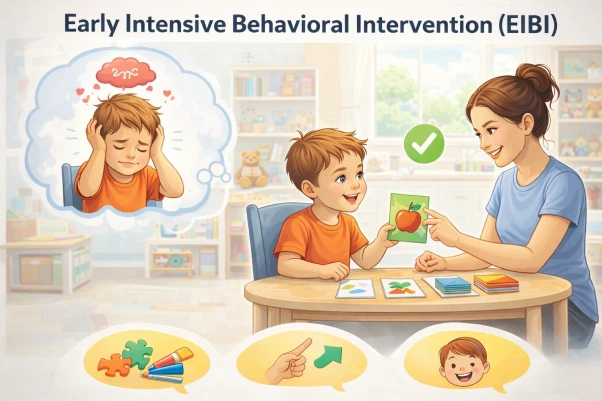
Early Intensive Behavioural Intervention (EIBI) is a structured teaching method that helps young children build foundational skills.
Instead of waiting for developmental gaps to close on their own, EIBI uses small, step-by-step learning to help the child catch up in crucial areas such as:
It introduces these skills in simple, manageable ways that children can understand and repeat — creating progress parents can see.
EIBI works because it takes big developmental tasks and breaks them down into smaller, teachable steps. It builds skills by repetition, positive reinforcement, and structured teaching.
Children learn how to:
EIBI creates new learning pathways by teaching children in a way their brains understand best.
Parents often notice signs like:
These are strong indicators that Early Intensive Behavioural Intervention can help shape early development.
Dr. Rajeshwari Ganesh is a Developmental & Behavioral Pediatrician who believes that every child offers unique insight into how they learn, respond, and perceive the world. Her work is guided by careful observation, curiosity, and respect for each child’s individual developmental profile.
Her medical journey began at Mumbai University, where she completed her MBBS and Diploma in Child Health (DCH). She then pursued advanced pediatric training through an MD in Pediatrics (USAIM), followed by the internationally recognized MRCPCH training pathway, further strengthening her clinical expertise.
Dr. Rajeshwari Ganesh completed an advanced fellowship in Developmental & Behavioral Pediatrics at the National University Hospital, Singapore, where she worked closely with children requiring early behavioral support, communication development, and structured developmental interventions.
Individualized, Observation-Led Care
In clinical practice, Dr. Rajeshwari Ganesh spends time closely observing how a child interacts, what they respond to, and how they communicate. She emphasizes that early intervention approaches such as Early Intensive Behavioral Intervention (EIBI) are most effective when grounded in a deep understanding of the child’s motivations, strengths, and challenges.
EIBI focuses on long-term, consistent learning. What makes it powerful is:
It is not just therapy — it is a learning style tailored to the child.
Parents often wonder what happens during EIBI sessions. Children learn:
Attention Skills
Sitting, looking, listening — the basics of learning.
Imitation
Copying sounds, actions, words, gestures.
Communication
Using gestures, pictures, sounds, or words to express needs.
Play Skills
Exploring toys, pretend play, turn-taking.
Daily Routines
Eating, brushing, washing hands, wearing clothes.
These skills build a foundation that helps children move confidently into preschool and daily life.
Families often express that working with Dr. Rajeshwari Ganesh feels supportive, comfortable, and direction-driven. Parents appreciate:
Her ability to blend medical knowledge with practical strategies makes EIBI easier for families to understand and apply.
Is EIBI only for autism?
Answer: Mostly, yes — but some principles help children with other developmental delays too.
Q. How long should EIBI continue?
Answer: It depends on the child’s progress — many begin with several months.
Q.Can parents do EIBI at home?
Answer:Yes. Parent training is a core part of EIBI.
Q. Will EIBI help non-speaking children?
Answer: It supports early communication and helps build language readiness.
Q. Is improvement guaranteed?
Answer: Every child progresses differently, but early intervention improves outcomes.
“My son began following instructions within weeks. The doctor’s clarity helped us so much.”
“She explained EIBI wonderfully. Our daughter started making better eye contact almost immediately.”
“Calm, warm, and knowledgeable — we finally understood how to help our child.”
Early intervention changes the way children learn, respond, and engage. Through structured sessions, positive reinforcement, and consistent teaching, Early Intensive Behavioural Intervention helps young children build the skills they need to participate more meaningfully in the world.
With her expertise, warmth, and clear guidance, Dr. Rajeshwari Ganesh continues to support families seeking reliable and effective EIBI Therapy for their children’s development.
Pinnacle Child Development Clinic, 202, 2nd Floor, Kanaiya Building, Opp. Airtel Store, Linking Road, Bandra West, Mumbai – 400050
📞 +91 77000 58024
📧 ganesh.ramaa@gmail.com
🌐 https://www.drrajeshwariganesh.com
🕒 Appointments available all days
Copyright © 2023 | Dr. Rajeshwari Ganesh.