

Pinnacle Child Development Clinic, 202, 2nd Floor, Kanaiya Building, Opp. Airtel Store, Linking Road, Bandra West, Mumbai - 400050


Bedwetting: A Quiet Struggle Many Families Share
In many home, bedwetting is handled quietly—extra bedsheets, discreet nighttime clean-ups, and a child waking up with a sense of embarrassment before anyone speaks. In India, nearly 20% of five-year-old children experience bedwetting at least once a month, and about 1% continue into adolescence. Despite being relatively common, bedwetting is often misunderstood and surrounded by unnecessary guilt, shame, and pressure on both the child and the family.
It is important to understand that bedwetting is not a behavioural issue, not laziness, and not a reflection of parenting. In most cases, it simply indicates that night-time bladder control and sleep regulation are still maturing. When families respond with patience, reassurance, and age-appropriate guidance rather than urgency or punishment, children feel emotionally secure—and dryness often follows naturally as development progresses.
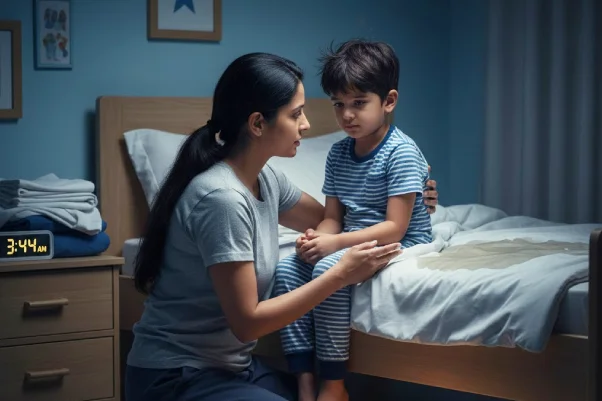
Bedwetting, medically called nocturnal enuresis, is the involuntary passing of urine during sleep in a child who is otherwise toilet trained during the day. Occasional bedwetting in young children is considered developmentally normal.
Nighttime bladder control is a complex process involving bladder capacity, hormone regulation, sleep depth, and brain–bladder communication. These systems mature at different speeds in different children.
Bedwetting usually becomes less frequent with age. While occasional wet nights are normal in early childhood, further evaluation may be required if:
In many cases, the brain simply does not wake the child in response to a full bladder—yet.
Certain conditions can increase the likelihood of bedwetting:
Anxiety and emotional stress
Children who wet the bed are more likely to experience anxiety, including separation anxiety, school phobia, or social anxiety. Stressful life events can trigger or worsen bedwetting.
Urinary tract infections (UTIs)
UTIs may cause frequent or urgent urination and can go unnoticed in younger children.
Constipation
A stool-filled rectum can press on the bladder, reducing its capacity and causing nighttime wetting.
Sleep apnea
Sleep-disordered breathing can increase nighttime urine production due to hormonal changes.
Children with ADHD, strong family history, or very deep sleep patterns may also be at higher risk.
Bedwetting can disrupt sleep when the child wakes up wet or needs assistance changing clothes or bedding. Falling back asleep afterward may be difficult.
Emotionally, bedwetting can lead to:
Repeated negative reactions from adults can intensify emotional distress and prolong the problem.
Managing bedwetting does not require punishment or shame. Helpful steps include:
Improving sleep hygiene—regular bedtimes, screen-free evenings, and a calm sleep environment—can improve bladder control at night.
If bedwetting persists, additional options may be considered:
Wetness alarms
These alarms detect moisture and wake the child when urination begins. Over time, they help train the brain to respond before wetting occurs. They should only be used with the child’s understanding and consent.
Pelvic floor exercises
In selected children, these exercises may improve bladder control.
Biofeedback
Biofeedback helps children become more aware of bodily signals and may benefit some cases.
Medical evaluation
If bedwetting continues, medical testing may be done to rule out UTIs, constipation, hormonal issues, or sleep disorders.
Parents should seek professional guidance if:
A structured developmental and behavioral evaluation helps identify contributing factors and guides individualized management.
Q. Is bedwetting normal after age five?
Answer:Occasional bedwetting can still be normal, but persistent patterns may need evaluation.
Q. Should children be punished for bedwetting?
Answer: No. Bedwetting is involuntary and punishment worsens anxiety.
Q. Does limiting fluids cure bedwetting?
Answer: Fluid timing helps, but restriction alone does not solve the problem.
Q. Will my child outgrow bedwetting?
Answer: Most children do, especially with supportive guidance.
Q. When should I consult a specialist?
Answer: If bedwetting is persistent, distressing, or accompanied by other symptoms.
“Once we stopped blaming and started supporting, our child improved steadily.”
“Understanding that it was developmental lifted a huge burden.”
“Guidance helped us pause and restart successfully.”
With over a decade of clinical experience, Dr. Rajeshwari Ganesh is a trusted Developmental and Behavioral Pediatrician in Mumbai, known for her calm, evidence-based, and parent-empowering approach.
She has completed advanced fellowship training in Developmental & Behavioral Pediatrics from the National University Hospital, Singapore, and holds internationally recognized qualifications including MRCPCH, MD Pediatrics, DCH, and MBBS from Mumbai University.
Her clinical expertise includes detailed developmental and behavioral evaluations using globally accepted tools such as Capute Scales, Amiel-Tison Scales, PEP, Early Start Denver Model Curriculum, CARS, and advanced neurodevelopmental assessments like PEER, PEERAMID, and PEEX2.
Dr. Rajeshwari Ganesh is among the few professionals in India certified to administer ADOS (Autism Diagnostic Observation Schedule) and the Bayley Scales of Infant and Toddler Development, both considered gold standards worldwide.
She also leads a high-risk neonate surveillance program at Surya Hospital, a tertiary NICU in Mumbai, focusing on early identification, intervention, and strong parental guidance. She regularly conducts workshops for parents, teachers, and healthcare professionals on child development.
Bedwetting is a developmental delay, not a disorder in most children. With reassurance, consistency, and patience, the vast majority of children achieve dry nights naturally. Early understanding and supportive care protect a child’s confidence and emotional well-being—ensuring that this phase passes quietly, without leaving lasting marks.
Pinnacle Child Development Clinic, 202, 2nd Floor, Kanaiya Building, Opp. Airtel Store, Linking Road, Bandra West, Mumbai – 400050
📞 +91 77000 58024
📧 ganesh.ramaa@gmail.com
🌐 https://www.drrajeshwariganesh.com
🕒 Open: 24×7 × 365 Days
Copyright © 2023 | Dr. Rajeshwari Ganesh.